Seattle Citroën
Challenger Motors
UPDATED 9/2026
Part 1 - The pre-war period
OVERVIEW
Any stories of Citroën dealerships in the USA really must start with Challenger Motors in Los Angeles. Challenger began selling Traction Avant Citroëns in early 1938, making them one of the first companies to import Citroëns into the USA. Challenger was not the first importer, but was the first successful importer of Citroëns.
The first company that I was able to find that tried to import Citroëns into the USA was called, Mutual Auto Credit of Philadelphia, Pennsylvania. They ran advertisements in local papers in the fall of 1936 for Traction Avant sales. It was an unsuccessful venture and by 1937 their ads disappeared and the building went on to be a Studebaker dealership.
Another importer of Citroëns in the 1930’s was a business called, Northwest Light Car, located in Portland, Oregon. Their first Traction Avants went on sale in 1939, a year or two after Challenger. Northwest Light Car managed to sell Traction Avants for about a year in Oregon, but this was brought to an abrupt halt due to France's entry into WWII.
Challenger however, went on to last with Citroën for 6 decades, making them the longest lasting Citroën dealer in North America...by a large margin.
A veteran automotive man named Donald Underwood Billings and several colleagues started Challenger Motors in late 1937. These men saw an opportunity to import Citroëns in order to capitalize on the French import car market that was sweeping Southern California in the 1930’s. Despite having several partners in the business, the man who was the driving force behind this effort was Donald U. Billings. In Part 1 of our story of Challenger Motors, we are going take a closer look at Don U. Billings and the initial formation of Challenger Motors.
Before we get started, I would like to thank Barbara (Billings) Schwartz, who graciously provided us with a large scrapbook she assembled with information about her family, including a treasure trove of information about her grandfather, Don U. Billings.

Los Angeles Times, December 1938

Los Angeles Times, February, 1939
AN AUTOMOBILE FAMIILY
The Billings family got a very early start in the automotive business. John Franklin (J.F.) Billings had an automobile business up and running in Topeka, Kansas, in the very early 1900’s. The business was called the J.F. Billings Auto Company and they bought, sold, and repaired cars. It was not long before they became a dealer for a variety of early twentieth century cars and trucks, including Moline-Knight, Stearns-Knight, Reo, Stafford, and others.

Topeka Daily, May 1919
J.F. Billings had three sons, and all three followed in their father’s footsteps and went into the auto business. The three sons were: Leonard Franklin Billings, Emmett Raymond Billings, and Donald Underwood Billings. It was the eldest son, Donald, who would go on to create Challenger Motors.
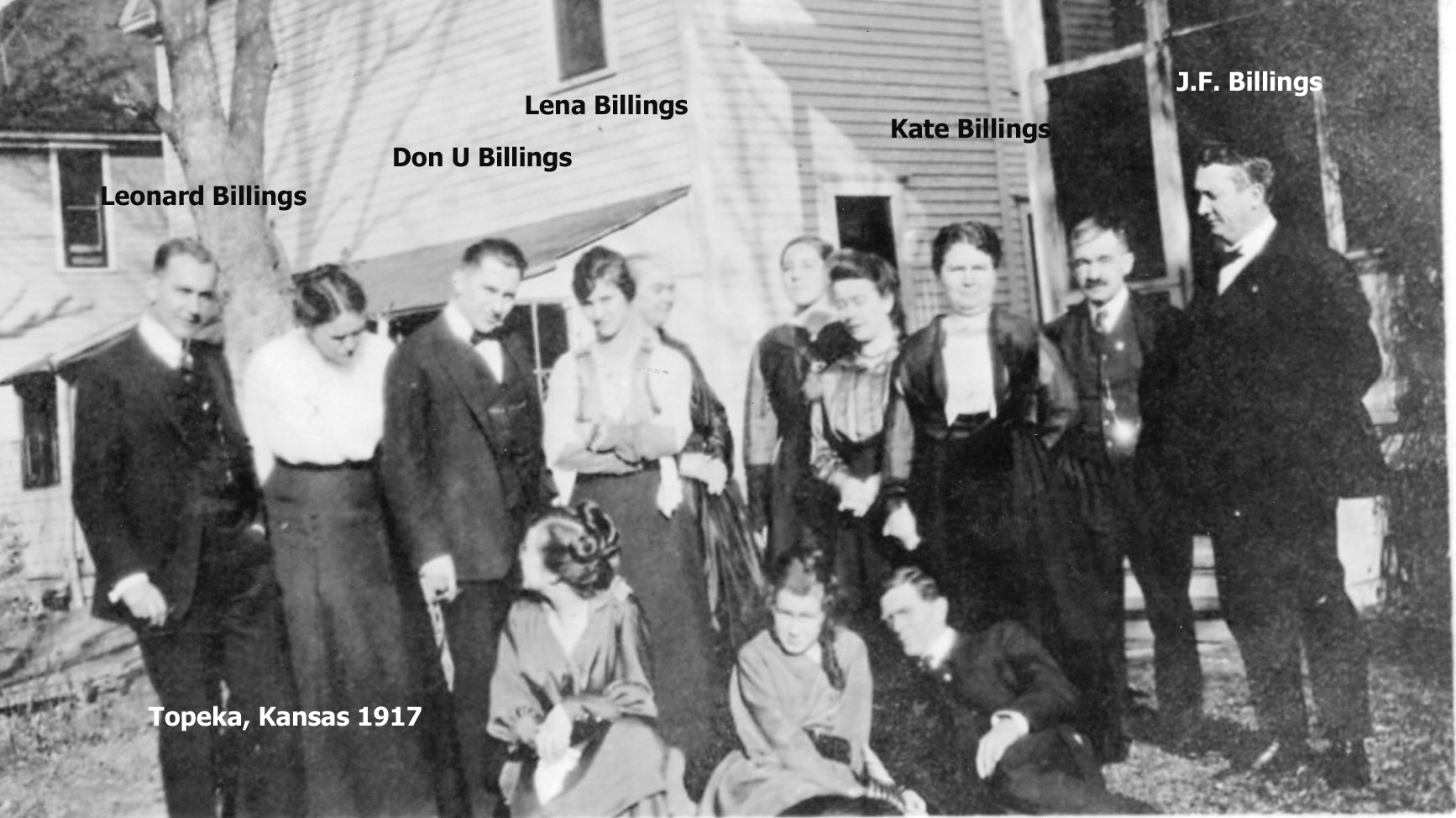
Billings family archives
BILLINGS FAMILY IN KANSAS, 1917
THE MOVE TO CALIFORNIA
J.F. Billings ran the garage in Topeka until 1921, at which time the family moved to southern California. At the time of the move, Don would have been about 29 years old.
In the spring of 1921, not long after their arrival in southern California, J.F. Billings purchased an existing automotive garage in Long Beach, called The Mission Garage. According to a 1921 newspaper article, sons L.F. and E.R. joined their father in running the new business. No mention was made if Don participated in this venture. Mission Garage had been a Willys Knight dealership and the Billings continued to offer them, along with Overland cars.


Billings family archives
MISSION GARAGE, EARLY 1920's
Long Beach Press Telegram, May 1921
The company ran uneventfully for a few years, but in 1924, father J.F. Billings passed away at the age of 58. After their father’s death, all three sons continued to be involved in automotive businesses, although all three drifted into their own ventures.
DON U. BILLINGS STRIKES OUT ON HIS OWN
In March of 1928, Don Billings (the eldest of the three sons) started a Willys Knight and Whippet dealership of his own in nearby San Pedro, California. He started out in a temporary location at 1306 S. Pacific Avenue, but relocated his business several times in the next few years. He later added additional cars, including Graham and Auburn automobiles.
A fantastic photo of one of Don U. Billings’ dealership buildings was provided by the Billings family (below). This particular location was at 554 American Avenue, in Long Beach. Neither the building nor the street name exists anymore. Apparently, American Avenue was renamed Long Beach Boulevard in 1959 and the entire area has been re-developed.

Billings Family Archives
DON U. BILLINGS IN A 1933 PHOTO
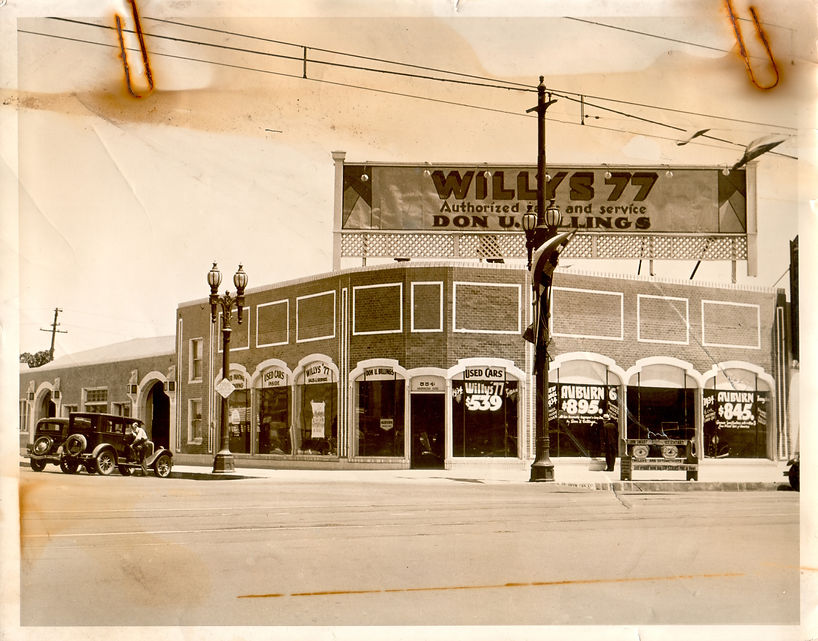
Billings Family Archive
ONE OF DON U. BILLINGS LOCATIONS – 554 AMERICAN AVENUE (~1933)
This venture kept Don U. Billings busy, but in this era, the automobile market was a fast-changing one and Don knew he would have to be on a continual lookout for the next automotive opportunity.
FORMATION OF CHALLENGER MOTORS
Don U. Billings kept scrupulous records – everything was written down in journals and much to my amazement, a few of these journals still exist and were provided to me by Don’s granddaughter, Barbara (Billings) Schwartz. The journals give us a never-before-seen in-depth look at the early days of Challenger Motors.
According to an article published many years ago in an old Citroën Car Club newsletter, Don U. Billings was watching the proliferation of sleek French cars that were becoming popular in Southern California in the 1930’s. Cars such as Bugatti, Delahaye, Delage, and Talbot-Lago were being imported to the USA, albeit in small numbers. These cars were eccentric, low-slung, and sleek - nothing like American cars of the era. But they were expensive, only available to the very wealthy.
Then along comes the Citroën Traction Avant in 1934. It had a beautiful, low-slung design that evoked the styling of the more exotic French cars of the era, but was priced for the masses. Don U. Billings became aware of the Traction Avant and decided to import and sell them.
Four pages of hand-written notes were jotted down by Don U. Billings in October of 1937. These pages outline his ideas for the structure of a new business that would offer Citroën Traction Avants. The very first item on page one identifies the name he chose for the company: Challenger Motor Car Company. If you read through Don’s notes, his description of the company function was lengthy - but to summarize, Challenger Motors’ charter would be to buy, sell, import, export, and finance automobiles.

Billings Family Archive
SAMPLE OF DON U. BILLINGS’ NOTES FROM OCTOBER 1937, OUTLINING PROPOSED COMPANY STRUCTURE FOR CHALLENGER MOTORS
He wrote that the board of directors for the new company would consist of five people: himself and his wife Lena, a man named Jacob Marion Wright, a man named Pearson Carmean, and Pearson’s wife, Bessie Carmean.
Pearson Carmean's name appears in several early newspaper articles about the company. Although little is known about Pearson Carmean, I did find that he initially worked as a banker and later became involved in hog ranching. A native of Kansas, Pearson Carmean relocated to Southern California in 1920 – about the same time as the Billings family. This raises the possibility that Pearson Carmean may have known the Billings family during their years in Kansas.
As for J. Marion Wright, I discovered that he was a native of Los Angeles and became a well-known civil rights attorney. He is best remembered for fighting for the rights of Japanese-Americans, both before and after WWII. He was especially well known for overturning the California Alien Land Law, which was put in place to prevent Japanese-Americans from owning land. He also was involved in a side business of hog ranching, in common with Pearson Carmean.
Pearson Carmean is listed as the president of Challenger Motors, J. Marion Wright as vice-president, and Don Underwood Billing as the general manager. However, Pearson Carmean and J. Marion Wright faded from the media spotlight quickly and their names were rarely mentioned again in association with Challenger Motors (even though they both remained involved until 1943). I believe that they were mainly investors. Don U. Billings was clearly the driving force behind the business.

PEARSON CARMEAN

J. MARION WRIGHT
THEIR FIRST CARS
The earliest indication that Don had imported Citroëns into the USA is provided by a copy of Autonews from September 29, 1937. The article introduces Don U. Billings as the new importer of the front wheel drive Citroën for Southern California. Note that at the time the article was created, the name Challenger Motors was not mentioned, presumably since the name had not yet been formalized. The article also notes that Don had moved to a new facility at 1355 South Flower Street in Los Angeles, a location that he would only use briefly.

Autonews, Sep 1937
I discovered that a Citroën Traction Avant was shown at the 1937 Los Angeles auto show, held a month after the above newspaper article was published. The car at the auto show is not positively linked to Don U. Billings in any of the media coverage, but it is almost certain that he was the man who provided the car. Below is a photo that was published in a local newspaper to support the car's upcoming appearance at the auto show. This is the earliest known photo of a Citroën Traction Avant in the USA.

LA Examiner, October 31, 1937
The following are the earliest two advertisements for Challenger Motors that I have been able to locate. The first was published in the Los Angeles Times on October 31, 1937, while the second did not appear until five months later, in April 1938. The October 1937 advertisement appears to have been a hastily released announcement intended to capitalize on the car's debut at the Los Angeles auto show. After this initial promotion, Challenger Motors fell silent in the press for several months, presumably while the company finalized its organization and business operations. By early 1938, however, the dealership appears to have been fully established and actively operating.


LA Times, April 24, 1938
LA Times, October 31, 1937
FIRST ADVERTISEMENTS I CAN FIND FOR CHALLENGER MOTORS
In the spring of 1938, they found a new location for their dealership: 1254 S. Figueroa Street in Los Angeles. By the time they moved to the Figueroa address, the Challenger Motor Car Company name was finally in widespread use, in both advertising and in the local media.
Based on available information, it is reasonable to conclude that Don U. Billings imported a small number of Citroëns in the fall of 1937, but the business really started in earnest in early 1938. The Challenger Motor Car Company name was first identified in October of 1937, but was not in widespread use until early 1938.
THE LICENSING PROBLEM
The 1930's were a pivotal time for auto dealers and importers in the state of California. Before this time, regulations for auto dealers and importers were scant, thereby allowing for widespread fraud and many other problems. But throughout the 1930's, several different laws were enacted in California that were intended to standardize rules, provide consumer protection, protect local businesses, ensure appropriate tariffs were paid, etc.
Because Citroën did not have an established corporate presence in California at the time, the cars could not be sold or registered normally. To legally bypass this bureaucratic hurdle, Challenger Motors had to apply for a state vehicle manufacturing license. Under this license, they were legally considered the manufacturer. As a result, all of their pre-war cars had a special Challenger serial number plate affixed to the car, in place of the original Citroën serial number plate (the Challenger serial number was the same as the original factory serial number). Due to this legal work-around, the cars had to be referred to with other names, such as Challengers or Challenger-Citroëns.
Since J. Marion Wright was a lawyer by trade, I would not be surprised if he was instrumental in setting up this scheme to comply with the rapidly changing laws.

Richard Voss
TYPICAL CHALLENGER SERIAL NUMBER PLATE
DON’S TRIP TO FRANCE
An important moment in Challenger Motors’ history came in the fall of 1938, when Don U. Billings traveled to France to conduct detailed, in-person talks with the Citroën factory. By the time of his trip, Challenger Motors had already established a dealership location and had successfully imported and sold a few Citroëns. Waiting until his business was operational and had proven that they could sell cars likely strengthened Billings’ bargaining position with Citroën. As we shall see, his efforts in Los Angeles during the previous year attracted the attention of Citroën’s president at the time, Pierre Boulanger.
In astonishing detail, Don U. Billings wrote down everything about his trip to France in a journal. His goal for the trip was to set up a financial agreement with Citroën and to more fully understand how to support the cars (spare parts, repair manuals etc).


Billings Family Archive
DON U. BILLINGS 1938 NOTEBOOK DETAILING HIS TRIP TO FRANCE
His trip started out on October 7, 1938. At 1:30 PM, he boarded the El Capitain train in Los Angeles and started his journey east, towards New York. He complained about the seats in the train and sketched some ideas in his journal for a better reclining seat.
He arrived in New York on October 11 and spent the night resting at the Commodore Hotel after the long trans-continental train ride in the uncomfortable seats. The next morning, he took a streetcar to the docks, where he boarded the SS Normandie and headed for Europe.

SS NORMANDIE
The first days of the cruise were uneventful, but a few days into the journey, the seas became rough. He wrote:
“…Sunday morning found me without sleep as the boat rolled and tossed just as I was going to sleep – all night long. (The) Normandie rolled 30 feet up and down and everyone felt the effect of the boat roll. Although I was not sea sick…”
The ship’s first stop was in South Hampton, England on October 17. After some passengers disembarked, the ship pulled anchor and sailed on to Le Harve, France. After disembarking, Don rushed to catch a train for Paris and during this train ride he wrote in his journal about how beautiful the French countryside was.
Once in Paris, he booked a room at the Le Grand Hotel in the 9th arrondissement. He seemed enraptured with the Parisian cafes and walked around absorbing the sights until midnight. While he loved the energy of the city, he did not appreciate the chaotic drivers and made several comments, including:
“...I have never seen such wild driving as I did in Paris. There is practically no signalling and traffic officers are confusing in their orders to the motorist…”
Don U. Billings woke up late the next morning at 11:00 AM, on Tuesday, October 18. His goal for the day was to go see the 1938 Paris auto show, called the, Salon de l'Automobile. This famous car show was held at the Grand Palais, adjacent to the river Seine. He roamed the auto show all afternoon and before he knew it, it was 7:00 PM and the show was closing for the day. His notes suggested that he was annoyed with himself for sleeping in so long.
The next morning, he spoke with a Citroën employee and was disappointed to learn that his planned visit to the Citroën factory would have to wait since his contact, a M. Guillet, would be out of town for a few days. He did however, arrange to buy a brand new 1939 11CV Traction Avant.
While waiting for M. Guillet to return, Don took the opportunity to take a boat trip across the Channel to London, where he spent a few days and was able to visit the British Citroën Factory in Slough.
By Sunday October 23, he was back in Paris. He collected his new Citroën 11CV Traction Avant and took it on a short trip to visit Chateau Fontainebleu, an hour or so south of Paris. He was quite impressed and made several notes about being able to experience Napoleon’s Palace.
THE FACTORY VISIT
On Monday, October 24 at 10:00 AM, he was finally able to meet with Citroën. Attending this meeting was none-other than Pierre Boulanger, President of Citroën at the time. To me, this signifies that Don U. Billings had enough credibility due to his Los Angeles operation to justify a meeting with the president of the company. It is worth noting that after Citroën’s 1934 bankruptcy, Citroën was probably anxious to sell cars. Perhaps they felt that the US market was part of that strategy.

PIERRE BOULANGER
Other Citroën employees in the meeting were: M. R. Blanchet, M. Arthur Lowenstein, M. Du Roure, and M. Guillet. The last two men specialized in wholesale sales. According to Richard Bonfond’s book, What a Ride, Growing up with Citroën in North America, one of the meeting attendees, Arthur J. Lowenstein, would later become involved in the formation of the Citroën American subsidiary, Citroën Cars Corporation and after that, Lowenstein became president of Michelin USA. Don specifically noted that of everyone in the room, he trusted M. Du Roure the most as he seemed the sincerest and lacked the bluster of the other sales person.
The group discussed the American automobile market. They also discussed the production rate of the Traction Avant, which was apparently low enough to result in an availability bottleneck. Citroën explained to Don that they were hesitant to hire more employees until they knew if the car would continue to be a success. Their hesitance to hire was due to the difficulty under French law to lay people off if sales slowed or didn’t materialize. They explained that to prevent over-hiring, they intended to ramp up production gradually while carefully monitoring sales and profits.
Don U. Billings also was able to negotiate a price reduction on the cars. In his notes from this trip, he suggested to Citroën that he would perhaps be able to buy 1000 cars. This allowed him to negotiate a final price of USD$435 each, without any contractual obligations specifying the number of cars he actually ordered.
In his spare time, Don jotted down expected peripheral costs in his journal. He estimated that the total cost he would have in each car by the time it was ready to sell in Los Angeles would be US $614.00. He allowed himself US$156.00 profit, bringing the total cost for a customer to an estimated $770.00. This matches up quite well with the price he ended up offering them for as his early advertisements were listing them at US$795.00 for some versions and $895 for others.
In the back of his journal, Don had previously written down several dozen topics that he wanted to discuss with Citroën. These included business-related things like prices, advertising, and dealer margins. But he also wanted to discuss technical topics such as special tools, spare parts, repair manuals printed in English, required maintenance, etc. One-by-one, he scratched a line through each item on his list as the Citroën team addressed them. Don had clearly been doing his homework in preparation for this trip.

Billings Family Archive
LIST OF TOPICS DON WANTED TO TALK ABOUT WITH CITROEN
One item that was not scratched out however, was the topic of safety glass. Various forms of safety glass had become the norm in the USA, from very early in automotive history. Henry Ford was instrumental as an early adopter of safety glass following several lawsuits against Ford after a series of gruesome fatalities early in his career. By the 1930’s, most US states had laws requiring safety glass.
Interestingly, both tempered and laminated safety glass had been developed in France and by 1937, French regulations appear to have required laminated glass for windshields and tempered glass for side and rear windows, same as in the US. Nevertheless, Don U. Billings budgeted US $20.00 to replace at least some of the glass in each car he imported.
After the meeting, the Citroën team took Don for a ride in a six-cylinder Traction Avant, a new model for 1938. He described the car as a “life saver,” noting its significantly improved performance over the four-cylinder version. He was also given a ride in a new Citroën diesel truck, though he had little to say about that experience.
Arthur Lowenstein, one of the meeting participants, agreed to accompany Don to visit the French transport company named, Compagnie Générale Transatlantique to discuss the logistics and cost of shipping cars to the United States. (This shipping company operated the SS Normandie, the ship he travelled to Europe on.)
The following day, a M. Blanchet from Citroën gave Don U. Billings a tour of the factory and answered many technical questions. Don noted that he was particularly impressed with Blanchet and felt he would be a valuable contact for future inquiries.

Billings Family Archive
DON U. BILLINGS SNAPSHOT OF THE PARIS FACTORY IN OCTOBER OF1938
Don took a particular interest in the Traction Avant’s gearbox, recording several observations in his journal. He even included a sketch illustrating the ring-and-pinion arrangement and the specialized tool used to adjust it. Transaxles were relatively uncommon in the 1930s, and early traction gearboxes were known to suffer from reliability issues. Given his year of experience with the Traction Avant in the United States prior to this trip, it’s likely Don was keenly aware of gearbox failures and wanted to learn more.
DON’S SKETCH OF GEARBOX PINION ADJUSTMENT TOOL

Billings Family Archive
A day later, Don went to a Solex factory near Paris where he met with representatives named M. Simonin and M. Biss. Don was told that an improved downdraft Solex carburetor was available for the 4-cylinder Traction Avant cars that increased top speed by 10 mph. Don bought six of them on the spot. Don said that the Solex people were very accommodating and spent all day with him and showed him around the factory.
Don also researched some spare part suppliers that were scattered around Paris and the environs. This included researching sources for Traction Avant tires that were likely not available in the USA.
Don capped his time off in France with side trips to Versailles, Verdun, and Reims. He also briefly visited Holland and Belgium. While in Brussels, he met with a representative from the Belgian Renault plant.
Once back in Paris, he purchased some spare parts from Citroën and then made arrangements to have his new Citroën Traction Avant shipped home. He sailed from La Harve on November 5, 1938. This time the seas were smoother.
Ten days later on November 14, 1938, he was back home in Los Angeles.
DON’S TRACTION ARRIVES IN THE USA
Don’s Traction Avant that he had picked up in Paris arrived in Los Angeles in early December 1938, a few weeks after he had returned.
Don was able to secure some media coverage for the arrival of the car, including this article from the December 7, 1938 Los Angeles Herald Examiner.
Based on notes in Don's journal, this particular car seems to have been loaded on the same ocean liner that he personally travelled on during his return trip from France, the SS Normandie. At the time, the Normandie's route was a repetitive one:
La Harve - Southhampton - New York - (return and repeat)
This means that the car would have been unloaded in New York and then sent by rail to Los Angeles.
It is unclear whether this was the standard method he used to ship his other Citroëns to the United States. In this era, there appear to have been only two plausible shipping routes. The first was the route described above, requiring a cross-country train. The second would have involved transporting the cars by sea from France directly to Los Angeles via the Panama Canal.

Los Angeles Herald Examiner, Dec 1938
DON'S 1939 TRACTION ARRIVING IN LOS ANGELES
Incidentally, the SS Normandie, the ship that Don U Billings used for his European travels, met a sad end in 1942 that involved some intrigue. You can read about the fate of the ship here HERE.
THE CHALLENGER-RENAULT
In the late 1930’s, Challenger Motors tried to import another French car using the Challenger manufacturer’s license; the Renault Juvaquatre. The Juvaquatre was originally conceived in 1936 by Louis Renault as a small, affordable car that went into production in 1937.
On November 3, 1938, while he was on his European trip, Don met with Renault. His notes contain very little about his visit with Renault, but he does say that they quoted him a price of US$506 for each Juvaquatre. Don was unsatisfied with this price and he told them it was unrealistic. He offered $400 instead, but there is no indication if this was agreed to by Renault.
He ultimately did come to some sort of an agreement with Renault since we know that he did import a number of them in the 1939/1940 time frame. Looking at period classified advertisements, it seems that most were 1940 models.

Los Angeles Examiner, Dec 1939

Los Angeles Times, September, 1939
Was the Challenger-Renault a success? It seems not so much. The car received almost zero media coverage, in stark contrast to the Citroëns. I also found a dealer in L.A. named Charles Niemann who was trying to sell twenty new 1940 Challenger-Renaults in 1943, suggesting that sales were difficult.
A really quite nice body badge from a Challenger Renault Juvaquatre was found by an NWCOC member at a swap meet.
Not only did a badge turn up, but a Challenger-Renault car surfaced in California in 2002. Unfortunately, this car is in sad condition and it is very likely that there are no other survivors. A photo of the car can be seen in the roster of surviving Challengers at the end of Part 2 of this article.

Lincoln Sarmanian
BODY BADGE FROM A CHALLENGER-RENAULT

CHALLENGER ADVERTISEMENT FROM ABOUT 1939

Los Angeles Times, February, 1939

THIRD PARTY DEALERSHIPS
In addition to selling the cars himself from his own dealership, Don U. Billings offered his cars (both the Citroëns and the Renaults) to third party dealers, thereby acting as a wholesaler (acting as a wholesaler was part of his vision for the company).
Third party dealers included other local L.A. companies, such as Fred R. Dean (a Nash dealer), Howard Darrin (a renowned auto designer who had a shop in L.A.), and Fred Fudge Motors. All of these dealerships advertised Challenger cars and apparently sold a few. An example advertisement follows.
Then there is Northwest Light Car in Portland Oregon. They briefly sold Traction Avants in 1939. While no link has been found, it is likely that they were getting their cars from Challenger.

Bilings family archive
ONE OF DON'S BUSINESS CARDS - SHOWING HIM AS A DISTRIBUTOR
THE NEW BUILDING
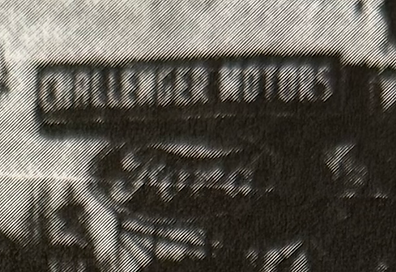
In 1939, Challenger Motors decided to move to a new location at 1160 S. Figueroa. The building they chose had been purpose-built as a car dealership two decades earlier. The previous tenant was Greer-Robbins, a dealer for Huppmobile, but Huppmobile went out of business in 1939, causing the building to become available.
Much to my delight, the Billings family provided a previously unseen photo of Challenger Motors in their new building at 1160 S. Figueroa. It is an incredible photo. Zoom in and look at some of the details. You can see that at the time the photo was taken in 1939, the Renault Juvaquatre was being offered at US$595 and the Traction’s price had gone up a bit, to US$895.

Billings Family Archive
CHALLENGER’S NEW LOCATION AT 1160 S. FIGUEROA ~1939

Things seemed to be going well for Don U. Billings and Challenger Motors.
TRACTION CABRIOLETS
Legend has it that many of the pre-war cars that Challenger imported were Traction Avant cabriolets. Based on newspaper classified advertisements for the Los Angeles area in the late 1930’s and early 1940’s, this seems to be true. I was lucky enough to obtain some original sales records from Challenger and sure enough, there were lots of cabriolets sold, many being 1938 models. It is safe to assume that Challenger sold quite a few cabriolets - probably dozens and dozens. The surviving cabriolets that I know of are listed at the end of Part 2 of this article. I suspect that not many Traction coupes were sold.

Photo provided by Toni Werk, photo probably early 1940's
CHALLENGER CABRIOLET PARKED IN FRONT OF MELROSE-SWEETZER GAS STATION - THIS PHOTO WAS USED FOR SOME OF THEIR BROCHURES AND SALES LITERATURE
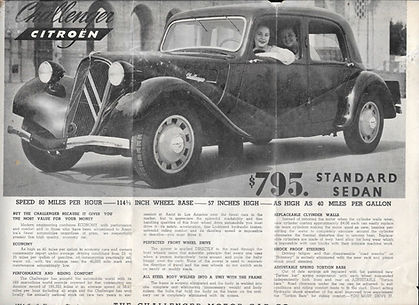
Will Kostman

Will Kostman
CHALLENGER BROCHURE - 1939
CHALLENGER AND STOCK CAR RACING
By early 1938, a handful of Traction Avants started showing up at various stock car races in Southern California. It was not initially clear where these cars were coming from, but with some digging, I found that they were all supplied by Challenger Motors. The cars performed extremely well in stock car racing, and generated quite a bit of positive publicity for Challenger Motors. What they lacked in horsepower, they more than made up for in handling, braking, and low center of gravity (it was common for other cars to roll over during track racing in this era).
Press coverage was widespread for the Citroëns and famous drivers of the era were singing the praises of the car.

Los Angeles Times, March 1939
A FORD ROLLS OVER, BUT THE CITROEN REMAINS SURE-FOOTED AND WINS THE RACE
A man named Rajo Jack (real name Dewey Gatson, but also known as One-eye Jack or Jack DeSoto) was a popular black race car driver in California in the 1930’s. In March of 1939, while driving a Ford, Rajo was defeated in a race at L.A.'s Southern Ascot raceway by a Challenger Citroën. The Citroën was driven by a sometimes rival, sometimes partner, named Bud Rose. The particular race was a grueling 400-lap stock car circuit and the Citroën won by a large margin; 10 full laps, while also establishing a new track record for time.
Rajo Jack was clearly impressed with the Citroën since he went on to use them (and win) in other races. For example, Rajo won the 250-mile stock car race in a Citroën that is discussed in the following newspaper article.

Richard Bonfond, Bonfond family archives
CHALLENGER LOGO ON DOOR

RAJO JACK

Oakland Tribune, May, 1940
There is a wonderful short movie clip of L.A.'s Ascot raceway with a Challenger Traction HERE. The Traction Avant in the clip was driven by Bud Rose, who went on to win the race!

Screen Grab from YouTube “Car Racing In California (1939)”
TRACTION AVANT (RIGHT) AT ASCOT RACEWAY IN LOS ANGELES IN 1939
Incidentally, if you want to learn more about Rajo Jack and the racing scene on the west coast of the USA in the 1930's and 1940's, I recommend this book, The Brown Bullet, Rajo Jack's Drive to Integrate Auto Racing by Bill Poehler.

DON’S SECOND TRIP TO FRANCE AND THE LOOMING WAR THREAT
Don visited France a second time, in June 1939, the same year he moved Challenger Motors into its new building at 1160 S. Figueroa. Without the benefit of detailed notes from this trip, his specific objectives remain unclear, though period newspaper accounts indicate that he once again met with Citroën officials. These newspaper reports reflect Don’s continued confidence in the Traction Avant and the business prospects for Challenger Motors - despite the threat of war hanging over Europe.
Don U. Billings tried to remain positive. In a July 1939 article in the Long Beach Sun, having just returned from his trip, Don said:
“…I’m (feeling) better that there won’t be a general war in Europe…”
Don’s optimism would soon prove misplaced.
There is a story published many years ago in a Citroën Club newsletter saying that a freighter carrying a shipment of Challenger’s cars was sunk by the Germans. I have been unable to verify this, but it is possible since a few freighters between Europe and the USA in the critical time window were indeed torpedoed. If this story is true, it would have been a stark warning to Don U. Billings.
It was only a few months after Don returned from his 1939 trip to Europe when Citroën was forced to slow civilian production as tensions in Europe escalated and the factory was called on to start producing military hardware.
France declared war on Germany on September 3, 1939. Then on June 3, 1940, the Citroën factory was bombed, bringing most production to a standstill.

Traction Avant, Le Grand Livre, Olivier de Serres
BOMBING DAMAGE AT JAVEL, JUNE 1940
This must have been devastating to Don U. Billings. All that he had worked for was now threatened.
ROUGH TIMES
With the war expanding in Europe and Citroën’s civilian auto production at a standstill, Challenger Motors no longer had new cars to sell, rendering the business unsustainable.
To try to keep the doors open, Don U. Billings and his partners attempted to take over a Ford dealership on 220 N. Virgil Street in late 1941. At the same time, their flagship dealership at 1160 S. Figueroa was relegated to used car sales, then later closed altogether.

Los Angeles Herald Examiner, Oct 1941.
CHALLENGER MOTORS WAS BRIEFLY A FORD DEALERSHIP -
JACOB MARION WRIGHT (LEFT), PEARSON CARMEAN (CENTER) AND DON U. BILLINGS (RIGHT)

Billings Family Archives
BUSINESS CARD FOR CHALLENGER’S FORD SALES ~1942
In a cruel twist, only a few months after Don U. Billings, J. Marion Wright, and Pearson Carmean took over the Ford dealership, the U.S. government ordered an end to civilian car production so the factories could be re-tooled to support the war. Newspaper reports indicate that the last civilian cars rolled off assembly lines in February of 1942, meaning that their ability to sell new Fords only lasted about five months.
As if the war was not enough, another major blow for Challenger Motors happened when Don U. Billings unexpectedly passed away on July 23, 1942. An obituary indicates that he died while at work. He was 50 years old. Apparently he had a heart attack while sitting at his desk.
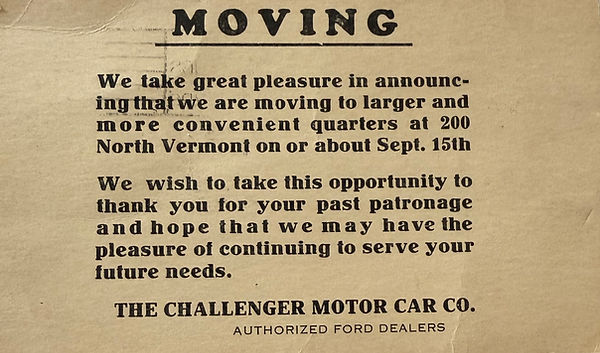
The business floundered under the Challenger Motor Car name for a few more months with another economizing move to 200 N. Vermont Street.
Billings Family Archives
MOVING NOTICE FOR CHALLENGER FORD (OCTOBER, 1942)
The outbreak of the war brought automobile manufacturing to a halt - first in Europe and later in the United States - making the business no longer viable. The situation was further compounded by the untimely death of Don Billings, the only member of the original three owners with an automotive background. The company's last advertisement appeared in March of 1943.
The Don U. Billings era for Challenger Motors was over. However, another chapter for Challenger Motors was about to begin…
